Trying to choose between the Marina and Cow Hollow for your first home? You are not alone. These two neighboring San Francisco districts share a lot of appeal, but they live differently once you look past the map. If you want a clearer way to compare price, home style, streets, and daily convenience, this guide will help you sort out what fits your budget and lifestyle best. Let’s dive in.
Start With the Big Picture
The Marina District and Cow Hollow sit side by side, which is why many first-time buyers compare them together. According to the Cow Hollow Association, Cow Hollow is generally bounded by Greenwich Street, Pierce Street, Pacific Avenue, and Lyon Street, with the north-south streets between Greenwich and Lombard included. Planning material defines the Marina as the area bounded by the Presidio, San Francisco Bay, Van Ness Avenue, and Lombard Street, making them close neighbors with overlapping lifestyle appeal.
Even so, they often feel different block to block. Based on San Francisco planning materials, the Marina tends to feel flatter and more uniform, while Cow Hollow is more varied in terrain and streetscape because of its sloping topography and terraced building pattern. That difference matters when you are thinking about your daily walk, bike ride, and the kind of home you want to come back to.
Marina Vs. Cow Hollow at a Glance
| Category | Marina District | Cow Hollow |
|---|---|---|
| Overall feel | Flatter, more uniform | Hillier, more varied |
| Housing pattern | More flats, condos, and apartment-style options | More architectural variety and house-like options |
| Main commercial corridor | Chestnut Street | Union Street |
| Walk Score | 94 | 94 |
| Transit Score | 67 | 68 |
| Bike Score | 91 | 70 |
| Median sale price | $1,945,000 | $3,075,000 |
| Market pace | About 11.5 days | About 17 days |
The market and score data above comes from Redfin neighborhood data. For many first-time buyers, the clearest split is simple: both neighborhoods are highly walkable and amenity-rich, but the Marina is usually the more attainable entry point.
Compare the Housing Stock
Marina Homes Feel More Uniform
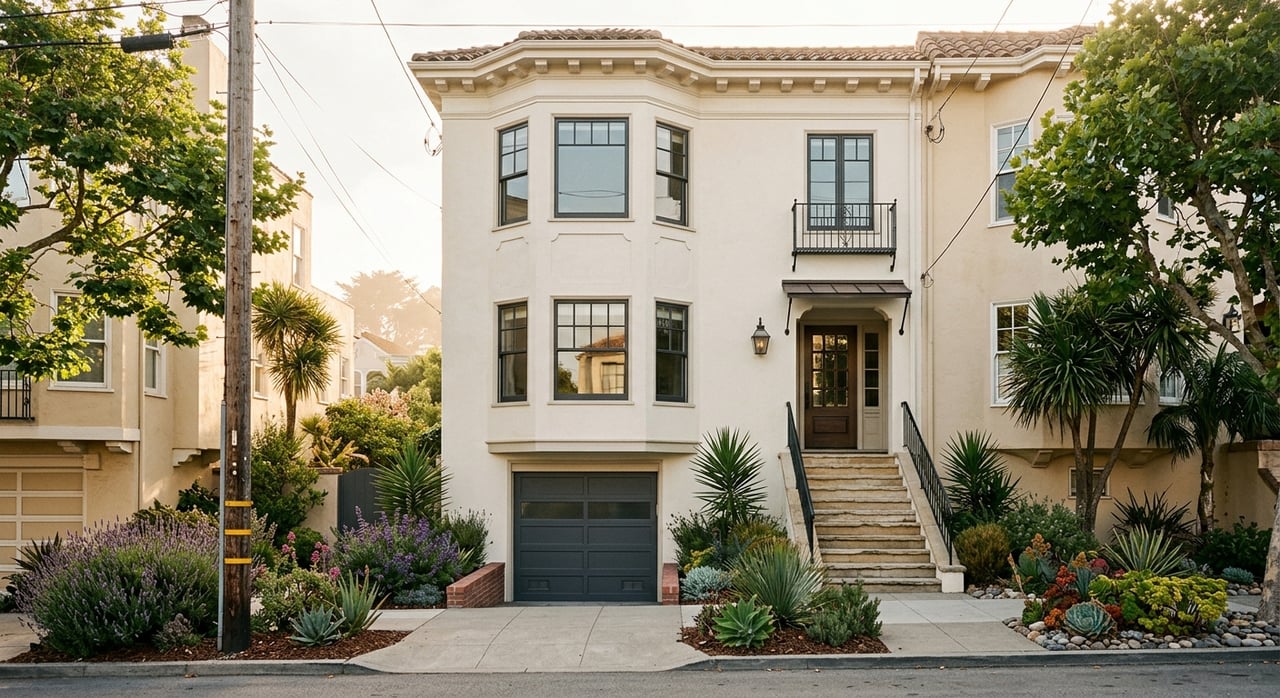
Planning materials describe the Marina as a predominantly residential neighborhood with flats, apartment buildings, and single-family dwellings. Much of the neighborhood took shape during a 1920s building boom, when lots were re-subdivided into standard parcels that fit flats and rowhouses, while larger corner lots often became small to mid-sized apartment buildings, according to San Francisco planning documentation.
Architecturally, the Marina is strongly associated with Mediterranean and Classical Revival buildings, with Art Deco appearing more often on larger corner apartment buildings. For you as a first-time buyer, that often means you may see more condo, flat, or apartment-style opportunities here than in a more house-dominant area.
Cow Hollow Offers More Variety
Cow Hollow has a more mixed architectural story. Its neighborhood design guidelines describe a neighborhood where one block can feature several architectural styles while still feeling cohesive overall.
The same guidelines identify a mix of housing types, including corner multi-family attached units and single-family detached homes. The neighborhood developed across multiple eras, so you will find Victorian, Edwardian, Mediterranean, Mission, Tudor, Romanesque Revival, and California Craftsman influences. If you like visual variety and more house-like character, Cow Hollow may feel more compelling.
Think About Terrain and Daily Comfort
Marina Is Easier if You Want Flatter Streets
If your day-to-day routine includes walking to coffee, carrying groceries home, or biking around the neighborhood, flatter streets can make a real difference. The Marina’s original gridiron layout on former marshland contributes to its more level feel, based on planning material for the district.
That can be especially appealing if you want simplicity in your first-home lifestyle. A flatter neighborhood can feel easier to navigate, especially when you are balancing work, errands, and social plans.
Cow Hollow Has More Hillside Character
Cow Hollow slopes downward toward the bay and has relatively few level lots, according to its design guidelines. The neighborhood places strong emphasis on topography, views, and stepped street walls, which creates a more layered and block-specific feel.
For some buyers, that is a major plus. You may prefer the added visual interest and the stronger sense that one street can feel very different from the next. But if ease and predictability matter most, the Marina may be the simpler fit.
Look at Everyday Convenience
Chestnut Street Shapes Marina Living
The Marina’s main commercial corridor is Chestnut Street, which SF Travel describes as a walkable stretch of restaurants, cafes, boutiques, retail, and historic movie theaters. The same source notes that Union Street and Chestnut Street run parallel through the area and highlights nearby destinations such as the Palace of Fine Arts, Fort Mason, Marina Green, and Crissy Field.
In practical terms, the Marina often offers an outdoors-plus-errands rhythm. You can access daily needs along Chestnut and stay close to some of the city’s best-known open-space destinations.
Union Street Anchors Cow Hollow
Cow Hollow centers more around Union Street, which SF Travel describes as a hub for specialty stores, retail, cafes, restaurants, fitness studios, and other services, much of it within preserved Victorian structures and old carriage houses. SF.gov’s Union Street guide also points to a wide mix of gyms, cycle shops, yoga, spas, beauty, health, fitness venues, boutiques, coffee shops, and sports bars.
That gives Cow Hollow a strong neighborhood main-street feel. If you want a corridor that feels centered on shopping, services, and daily routine, Cow Hollow checks that box well.
Compare Walkability and Transportation
Both neighborhoods are highly walkable, with a Walk Score of 94 according to Redfin. That means you are not really choosing between walkable and not walkable. You are choosing between two different styles of city living.
The transportation split is a little more helpful. Redfin reports a transit score of 67 for the Marina and 68 for Cow Hollow, while the bike score is 91 for the Marina and 70 for Cow Hollow. If biking is part of your regular routine, the Marina has a meaningful edge.
Understand the Price Difference
For first-time buyers, budget often decides the conversation quickly. On Redfin, the Marina District’s median sale price was $1,945,000 in February 2026, compared with $3,075,000 for Cow Hollow.
That is a significant gap. It suggests that Cow Hollow typically asks more from your budget upfront, while the Marina is more likely to offer an entry point that feels realistic if you are buying your first home in this part of San Francisco.
Redfin also shows both neighborhoods as competitive, but the Marina is tighter. Homes there sold in about 11.5 days with a competitiveness score of 98, while Cow Hollow homes sold in about 17 days with a score of 93. In other words, the Marina may be more attainable than Cow Hollow, but you still need to be prepared to move quickly.
Which Neighborhood Fits You Best?
Choose the Marina If You Want:
- A lower price point relative to Cow Hollow
- Flatter streets and easier biking
- More uniform housing stock
- Strong access to Chestnut Street and nearby open space
- A first-home search focused on condos, flats, or apartment-style living
Choose Cow Hollow If You Want:
- More architectural variety
- A hillier, more layered neighborhood feel
- More house-like or multifamily-attached options
- Daily life centered around Union Street services and retail
- More flexibility to prioritize character over entry price
A Smart First-Home Lens
When you compare these two neighborhoods, the real decision is usually not about whether one is better. It is about what kind of first-home experience you want and what your budget can comfortably support.
The Marina often makes sense if you want a more straightforward entry into a highly walkable, amenity-rich neighborhood with flatter streets and stronger bikeability. Cow Hollow often makes sense if you are drawn to architectural variety, topographic character, and a more house-like feel, and you are prepared for a higher price floor.
If you want help weighing the tradeoffs between blocks, building types, and offer strategy, Faye Dibachi can help you make a confident decision with clear, local guidance.
FAQs
Is the Marina or Cow Hollow better for a first-time homebuyer in San Francisco?
- For many first-time buyers, the Marina is often the more attainable option because current sold-price data shows a lower median sale price than Cow Hollow, while both neighborhoods remain highly walkable and amenity-rich.
What is the main housing difference between the Marina and Cow Hollow?
- The Marina generally has more flats, condos, and apartment-style homes in a more uniform 1920s-era setting, while Cow Hollow offers more architectural variety and a mix that includes more house-like and multifamily-attached options.
Are the Marina and Cow Hollow both walkable neighborhoods?
- Yes. Redfin reports a Walk Score of 94 for both neighborhoods, which means each supports a walkable lifestyle with easy access to shops, dining, and services.
Is the Marina more affordable than Cow Hollow?
- Yes. Redfin reports a February 2026 median sale price of $1,945,000 for the Marina District and $3,075,000 for Cow Hollow.
Which neighborhood is better for biking, the Marina or Cow Hollow?
- The Marina currently has the stronger bike score, with Redfin reporting a bike score of 91 for the Marina compared with 70 for Cow Hollow.
What streets are the main lifestyle hubs in the Marina and Cow Hollow?
- Chestnut Street is the Marina’s main commercial corridor, while Union Street serves as the central retail and services corridor for Cow Hollow.